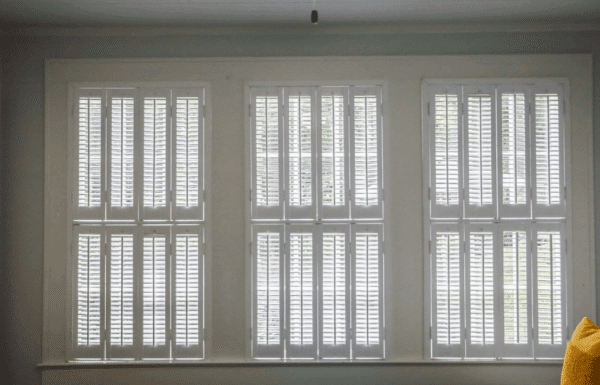

Most homeowners view window dressings as purely decorative, but we approach them as a critical mechanical layer of the home. Professional bedroom shutters create a secondary architectural barrier against the glass, managing the precise regulation of light and heat. This setup offers a permanent, dust-free way to control the external factors that usually ruin a good night’s sleep.
We always look at the window substrate first. The foundation, such as an original Victorian box sash or a modern aluminium profile, dictates which material will actually last. A room’s specific micro-climate affects how a shutter performs over time, so material specification is never a one-size-fits-all process.
Paulownia hardwood shutters remain our primary recommendation for main bedrooms. This timber offers exceptional grain stability, meaning the slats won’t warp or twist under temperature changes. Its low thermal conductivity provides a natural insulator that breaks the thermal bridge between the cold glass and the room’s interior. In en-suites or bedrooms prone to humidity, we shift to high-grade waterproof shutters. These closed-cell composites resist moisture to prevent mould growth, keeping the air quality of your restorative space clean and safe.
In the world of thermal performance, we measure a material’s resistance to heat flow using the ‘R-value’. To put this in perspective, a standard roller blind typically carries an R-value of roughly 1.4. In contrast, a professionally fitted hardwood bedroom shutters installation can reach values as high as 3.17.
This matters because your bedroom windows are the primary point of thermal failure in your home. By installing timber with a high R-value, you create a thermal envelope. During a Surrey winter, these bedroom shutters can reduce heat loss through the glass by up to 51%. It turns the window from a cold draught-source into a temperature-stable boundary, allowing your heating system to work less while you sleep.
London and Surrey residential zones now contend with high-intensity LED street lighting. These modern LEDs emit a concentrated blue-light spectrum that suppresses melatonin and makes deep sleep cycles harder to reach. Most off-the-shelf blinds fail here because they allow light to bleed around the edges, creating a glowing ‘halo’ that keeps the brain in a state of semi-alertness.
Bespoke bedroom shutters provide the most reliable answer to this light pollution. We fit every panel to the millimetre within the recess to kill off peripheral light bleed. By creating a mechanical seal against the window frame, our bedroom shutters anchor the lighting environment and support the natural circadian rhythm of the body.
Recent clinical studies have shifted how we view sleep hygiene. Research now shows that even ‘dim’ light pollution, at levels as low as 5 lux from a nearby streetlamp, can inhibit melatonin production and trigger minor systemic inflammation. For true restorative health, you must cross the threshold into total darkness. This is the logic behind our integrated blackout shutters. By eliminating the final percentage of light bleed that standard window dressings miss, these bedroom shutters provide a medically sound environment where the brain can fully transition into deep-cycle REM sleep.
The way a paint finish reacts to natural light depends entirely on room orientation. This makes colour selection a functional decision.
Even high-quality louvred products have tiny tolerances where light can pass through. If you require zero light, integrated blackout blinds are the specific technical solution we recommend.
This setup involves a honeycomb cell blind that sits within a dedicated channel behind the shutter panels. You get the daytime privacy of a shutter combined with the technical blackout needed for sleep. High-performance bedroom shutters are the only reliable method for turning an urban bedroom into a space where you can actually switch off.
Dense Basswood shutters are the best choice for dissipating external energy. Timber is a porous material with a cellular structure that naturally acts as an acoustic baffle, breaking up sound waves before they hit the glass. This makes hardwood much more effective than lighter composites if you live near a busy road or transit hub. While no shutter is soundproof, a timber installation shifts the acoustic signature of a bedroom from hollow to hushed.
Curtains operate on an ‘all or nothing’ basis because they are either fully open or fully closed. For those with a ground-floor bedroom or neighbours overlooking the garden, this is a significant practical flaw.
The tilt mechanism of a shutter solves this perfectly. Angling the slats upward floods the ceiling with natural light but keeps the view from the street completely obscured. You can go about your morning routine in natural light while remaining hidden from the outside world.
Beyond the biological benefits, there is a clear financial argument for shutters. In the competitive property markets of London and the Home Counties, kerb appeal is a measurable asset. Estate agents frequently note that buyers form an opinion of a property within the first seven seconds of arrival.
Standard curtains often appear mismatched from the street. In contrast, bedroom shutters provide a clean, symmetrical architectural finish. Their status as a permanent fixture, as opposed to a ‘soft furnishing’, adds to the tangible valuation of the home. They represent a rare interior upgrade offering a genuine return on investment (ROI).
Since 2006, our team has approached window furniture from a carpenter’s perspective. A bedroom shutter represents a long-term structural investment in your home. Our process covers everything from the initial moisture check of the window recess to the final, millimetre-perfect installation.
Book a design consultation today to discover how we can technically optimise your bedroom for better rest.